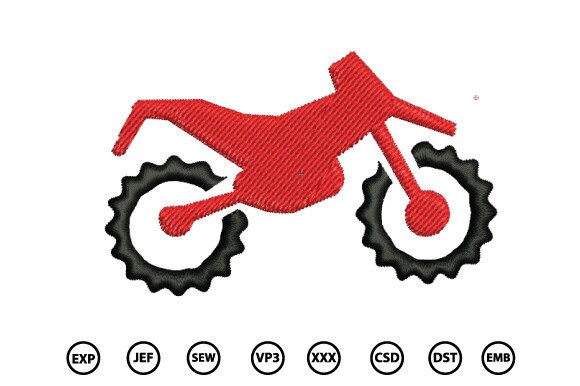
Motor Bike Embroidery Design Review
First Impression: Whimsy with a Hint of Grit
When I opened the Motor Bike machine embroidery design, what struck me wasn’t technical precision first—but personality. It’s got that charming, slightly stylized silhouette: clean curves, a friendly front wheel, and just enough line work to suggest motion without overcomplicating things. It doesn’t scream “motorcycle club” or “racing logo.” Instead, it leans into gentle nostalgia—think vintage postcard meets modern cottagecore. That makes Motor Bike unusually versatile for a Transportation-themed embroidery file. It reads as playful on a baby onesie, warm on a linen tea towel, and quietly confident on a canvas tote bag meant for weekend markets.
A Real-World Test: The Custom Tote Bag Project
Last week, I stitched Motor Bike onto a natural cotton canvas tote for a local artisanal coffee roaster’s pop-up booth. We used medium-weight cutaway stabilizer, 40-weight polyester thread in charcoal gray and cream, and a 5x7 hoop. The result? Crisp satin stitch outlines held beautifully, fill stitches stayed even across the fuel tank and seat, and the running stitch accents (like the subtle handlebar detail) added just enough texture—not so much that they snagged during handling. Customers paused at the booth, smiled, and asked, “Is that *your* bike?” That’s the quiet power of this design: it invites connection, not just recognition.
Where Motor Bike Shines—and Where It Needs Thought
- Custom apparel: Works cleanly on sweatshirt cuffs, chest pockets, and sleeve hems—especially on midweight knits with proper stabilizing. Avoid ultra-thin t-shirts unless you reduce stitch density or simplify the file first.
- Baby embroidery & nursery decor: Its soft edges and lack of aggressive angles make it ideal for onesies, burp cloths, and pillow covers. Just skip metallic threads—stick with matte cotton or poly for safety and washability.
- Towels & textured fabrics: On waffle-weave tea towels, I added a layer of tear-away + topping. The design held its shape well—even around the wheel spokes—because the stitch density isn’t overly aggressive.
- Patches & caps: Use caution here. The rear wheel curve and narrow fork area can distort on curved cap fronts. For embroidered patches, consider digitizing a simplified version—or pair Motor Bike with a clean border to anchor it visually.
- Dark fabric & layered garments: Contrast matters. On navy twill or black denim, I tested both light gray and ecru thread. Ecru won—it softened the look, kept it approachable, and avoided a harsh “logo” feel. Always run a black-and-white mockup before finalizing thread colors.
What This Design Says About Your Brand—Without Words
When you choose Motor Bike for your craft business or Etsy shop, you’re signaling warmth, intentionality, and subtle storytelling. It doesn’t shout. It fits naturally alongside hand-stitched mugs, pressed botanical prints, or locally made candles—not flashy tech gear or corporate merch. That alignment builds customer trust: people sense when a design feels *chosen*, not just dropped in. For handmade product listings, pairing Motor Bike with lifestyle photos (e.g., the tote bag slung over a bicycle basket, or a pillow cover beside a stack of well-loved paperbacks) elevates perceived value far beyond the stitch count.
Practical Designer Notes You’ll Actually Use
Before stitching Motor Bike on your next project, try these:
- Test on scrap fabric first—especially if using textured weaves, stretchy knits, or dark backgrounds. Note how the wheel spokes and seat seam hold up.
- Review stitch density. If your machine struggles with dense fills on lightweight fabric, consider reducing density by 5–10% in the fill areas only—not the satin outlines.
- Confirm hoop size compatibility. Since the description mentions “comes with mu…” (likely cut-off), double-check your file package for 4x4, 5x7, and 6x10 versions—or reach out to the seller. A single hoop size limits flexibility for small-shop products like keychain patches or baby bibs.
- Inspect small details under magnification: the headlight dot, chain link hint, and footpeg lines should be legible at 3 inches wide. If they blur or vanish, it’s likely too small for fine-detail work.
- Use proper stabilizer: Cutaway for knits and towels, tear-away for stable wovens, and a light topping for napped fabrics like terry cloth.
- Check licensing. If you plan to sell finished products (e.g., embroidered aprons for a bakery) or resell digital embroidery files, confirm whether Motor Bike is licensed for commercial use. When in doubt, assume personal use only until verified.
Final Thought: Not Just a Design—A Conversation Starter
Motor Bike isn’t about horsepower or high-speed realism. It’s about charm with character—ideal for makers who want their embroidery to feel human-scaled, not mass-produced. It works in holiday embroidery (think “Santa’s Ride” on a stocking), wedding gifts (“His & Hers” motorcycle motifs on linen napkins), and boutique branding where authenticity matters more than flash. As an embroidery designer and longtime reviewer, I keep Motor Bike in my go-to folder for projects where personality > polish, and where the finished product should spark a smile—not just check a box. Just remember: great embroidery starts with thoughtful testing, not perfect specs. Stitch it smart, and let the whimsy do the rest.